
Description
What Will You Learn from This Book?
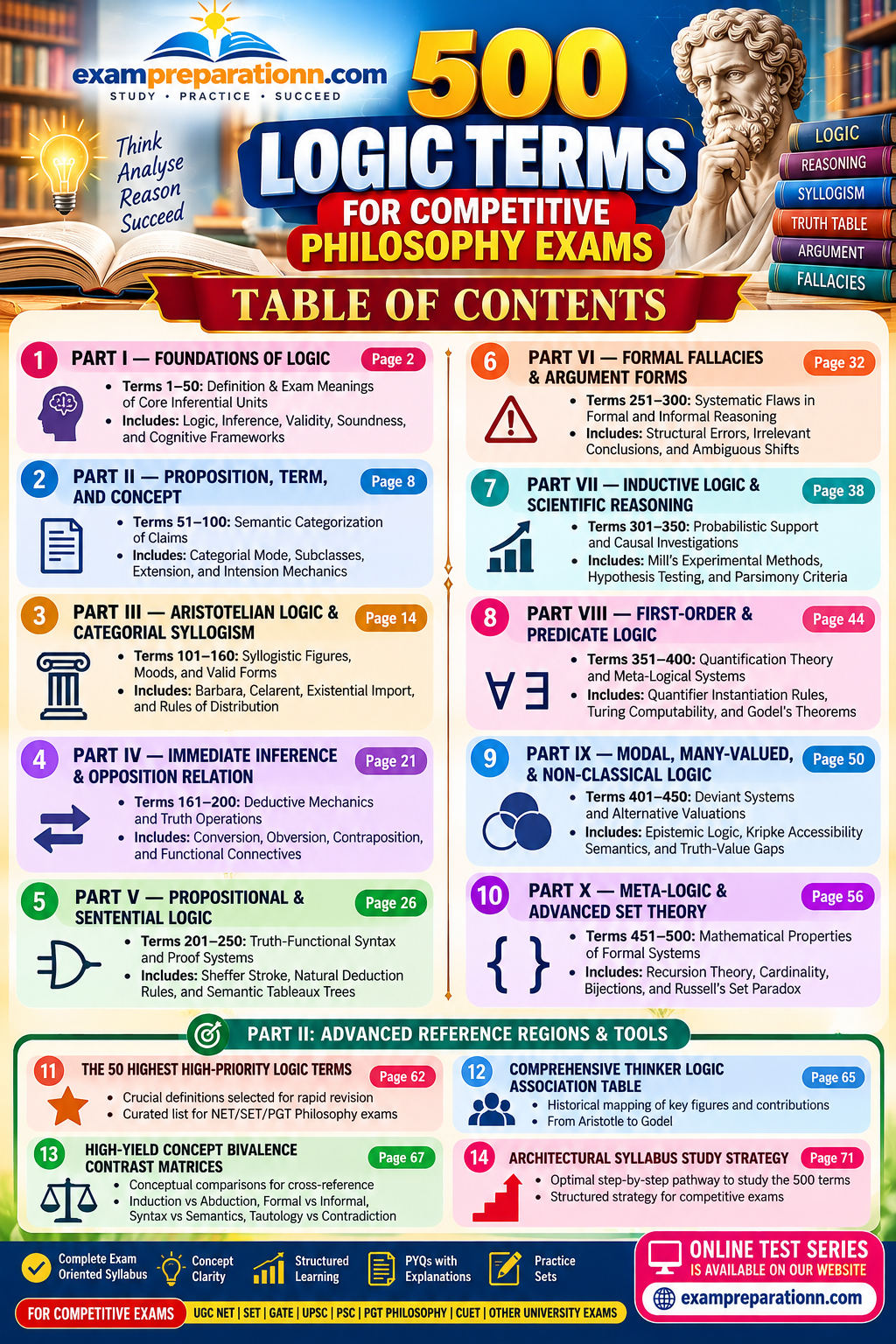
The book is organised into ten major sections, progressing from foundational concepts to advanced topics in logic.
- Foundations of Logic: Reasoning, inference, validity, soundness, deduction, induction, and logical consequence.
- Proposition, Term, and Concept: Categorical propositions, extension, intension, denotation, connotation, and distribution.
- Aristotelian Logic and Categorical Syllogism: Syllogistic figures, moods, Barbara, Celarent, Darii, Ferio, and rules of syllogistic reasoning.
- Immediate Inference and Opposition: Conversion, obversion, contraposition, subalternation, and the traditional square of opposition.
- Propositional and Sentential Logic: Truth tables, logical connectives, tautologies, truth-functional operations, and rules of inference.
- Formal Fallacies and Argument Forms: Important errors in reasoning and the evaluation of arguments.
- Inductive Logic and Scientific Reasoning: Mill’s experimental methods, causal reasoning, hypothesis testing, and inductive support.
- First-Order and Predicate Logic: Quantifiers, quantification rules, and metalogical concepts.
- Modal and Non-Classical Logic: Alternative logical systems, epistemic logic, and many-valued logic.
- Metalogic and Advanced Set Theory: Recursion theory, cardinality, bijections, and Russell’s set paradox.
Special Features of This Logic E-Book
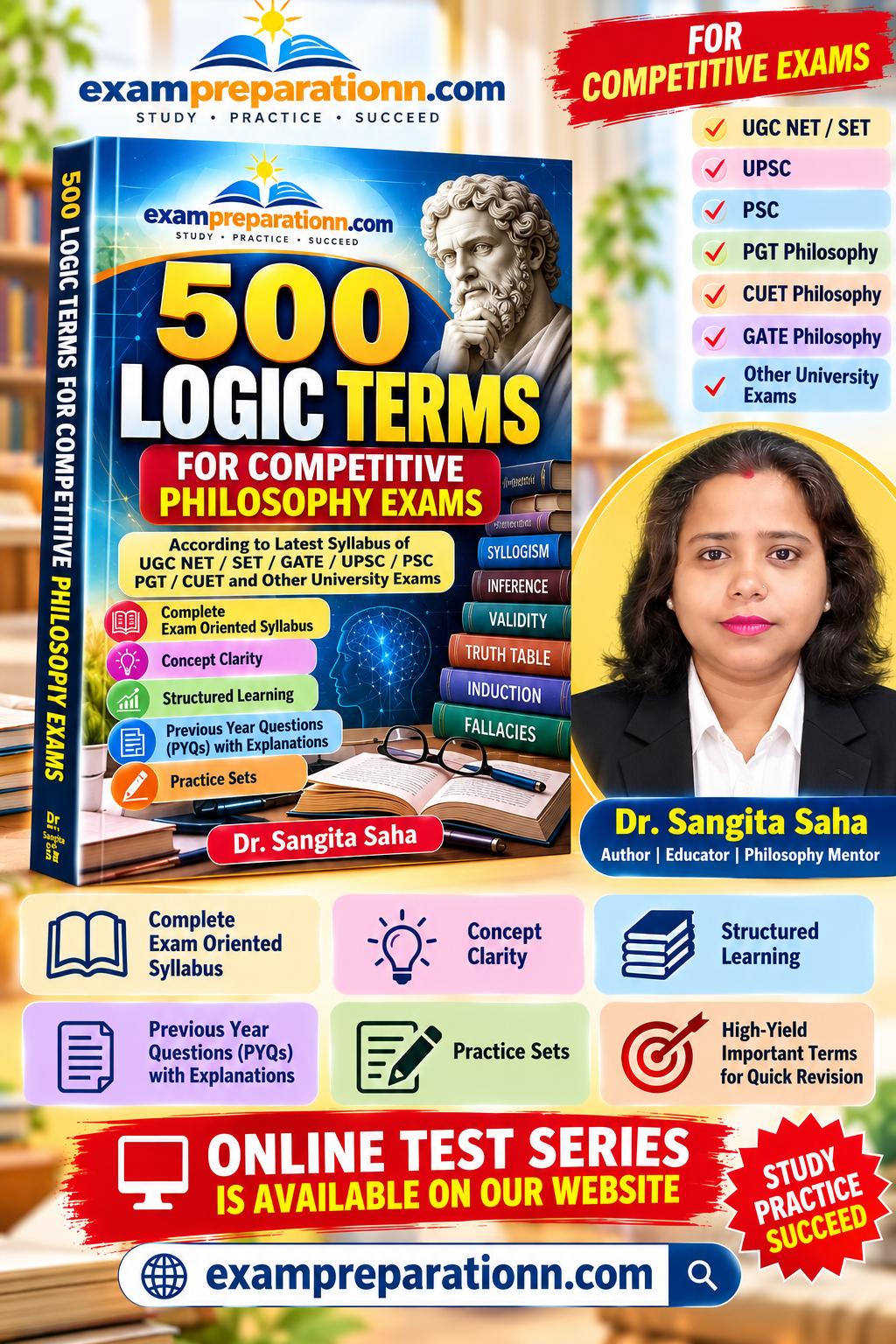
- 500 essential logic terms with definitions and exam-oriented meanings.
- Ten systematically arranged topic sections.
- A list of 50 high-priority logic terms for rapid revision.
- A comprehensive table connecting important thinkers with their contributions to logic.
- Comparative matrices covering key logical concepts and distinctions.
- A structured study strategy to help organise your preparation.
- A syllabus-oriented approach for competitive Philosophy examinations.
Who Should Read This Book?
This e-book is suitable for:
- UGC NET and SET Philosophy aspirants.
- GATE Philosophy examination candidates.
- UP PGT and other PGT Philosophy aspirants.
- UPSC and State PSC candidates studying relevant logic topics.
- CUET Philosophy aspirants.
- Philosophy postgraduate students and university learners.
- Teachers and educators looking for a structured logic reference.
Reviews
There are no reviews yet.